February 24, 2013

Roots -- and Branches


Growing up as an only child, I was always fascinated by large families. My own was quite small and most of its members were rather shadowy figures to me. Some had died before I was born or when I was a child. I saw the others only a few days each year at the most. It wasn’t until I grew up that I realized that the relatives I did know were almost all from my father’s family.
Of my mother’s family, I had only a few facts, jumbled like a jigsaw puzzle waiting to be assembled. I knew that, though Mummy had been born in a town called Royalton, Illinois, she identified proudly as a Texan. Her family had moved there when she was a baby. I knew her parents had divorced when she was a teenager and she had an older brother. I had fond memories of Grandma whom we visited every summer until she died when I was about 12. I never saw Granddaddy, though I did meet his second wife, Nell, when I was about 7. We visited them in Houston, Texas because Granddaddy was ill -- too sick for a little girl to be allowed to visit him. I met my Uncle Marion for the first and last time the summer after Grandma died.
The only other relatives of my mother’s I knew were her Uncle Quincy and Aunt Cora. Until we went to visit them in Missouri when I was about 10, I’m not sure I realized that grown-ups could have uncles. I have vivid and pleasant memories of them – Uncle Quincy was a fascinating storyteller and Aunt Cora taught me to play cribbage. But we never saw them again.
When Mummy died 26 years ago, I found a couple from Illinois with her maiden name in her address book. I had no idea who they were but I thought I should inform them of her death. I assumed they must be cousins but, though I got an occasional signed Christmas card from them after that, I was never sure. Then, in 2008 I got a long e-mail. The writer identified herself as my mother’s cousin’s wife and mentioned children, grandchildren and great-grandchildren – over a dozen relatives whose existence I’d been completely unaware of. A year later I “met” one of her grandchildren on Facebook.
When I decided to visit my Lost Cousin  in California this summer, I thought it would be only fitting to give equal time to my mother’s family. And so it was, in late June, that I found myself on a train heading towards my roots.
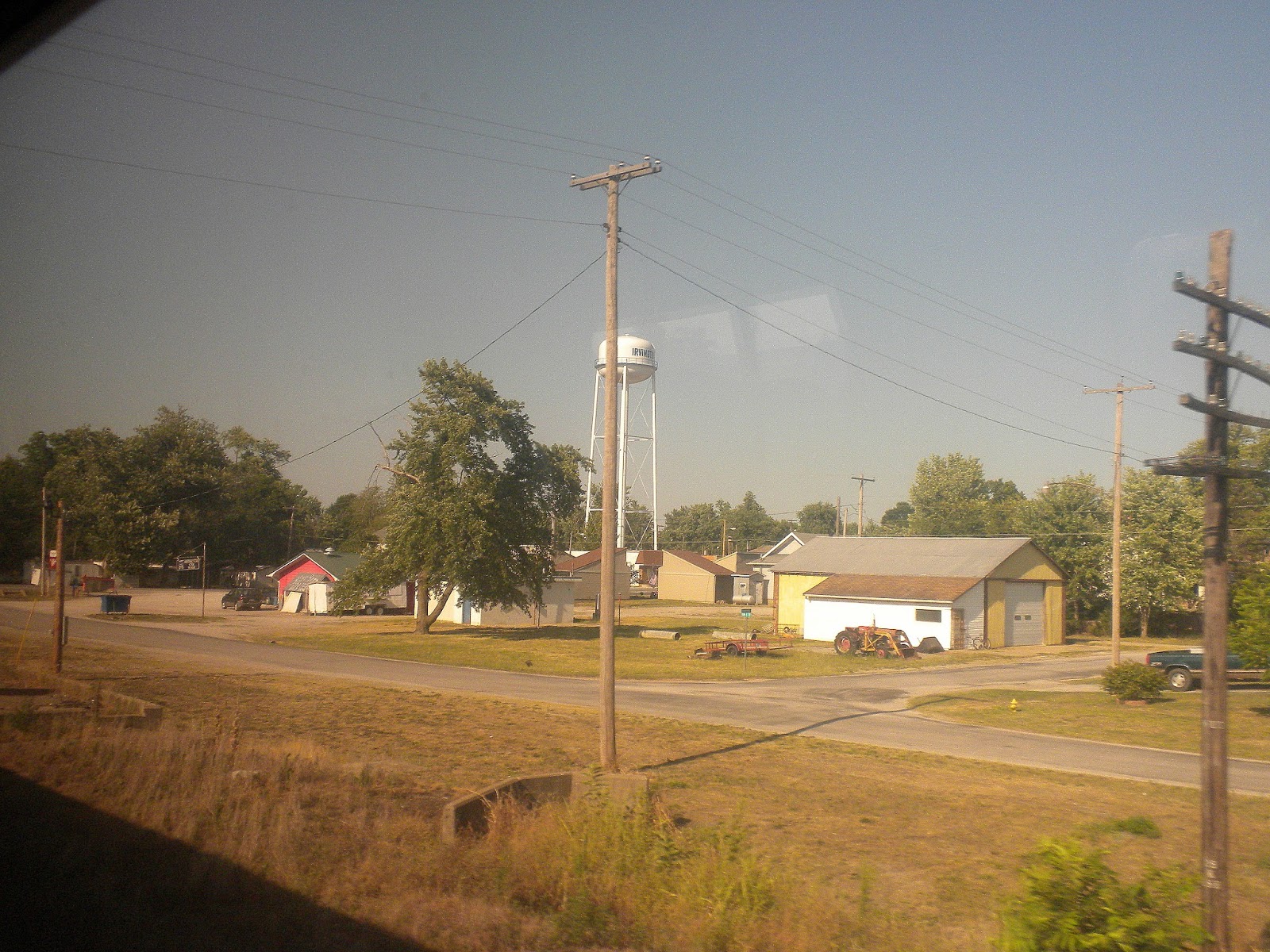


There followed three days packed with discovery of previously unknown places, people and family history. I felt like I was in one of the family saga books I’d always loved. Only this was my family saga. I had cousins that lived on a road that was named for them – and my mother.


My mother’s cousin’s wife took me along a, to her, familiar road


to a private cemetery where every grave was that of one of my ancestors.


She showed me the site of my great grandfather’s home along an old Indian trail 


and the Old Home Place itself, moved, years ago to a different location 


where one of my second cousins still lives.

I saw the town where my mother was born,


the church that my granddaddy built there,


and, in the Royalton cemetery, his younger brother Oren’s grave (father, grandfather, great-grandfather and great-great grandfather of all the cousins I was visiting).


Finally, she took me to my own grandfather’s grave in a nearby, even smaller town.


The next day, my mind in a whirl at the end of a cousin-filled pizza party, I relaxed in a Southern Illinois summer evening,


and contemplated the complexities of families. In every one, there are wanderers and home lovers. I’m a third generation wanderer. My great-uncle Oren’s part of the family dug their roots in deep. I’m so glad they let me wander back this summer to discover them.


February 12, 2013

Summer in the City


I’d have been even more disappointed to leave Southern California if I hadn’t known my adventure wasn’t over. I had more cousins to meet. But before that, it was time for a weekend in Chicago, a place I had always had a special relationship with -- more than a visitor but never quite a resident.


Several of my father’s relatives had lived in or near Chicago. My parents had worked there when they were first married. But, for me, Chicago always meant summer. I had spent part of many summer vacations there visiting relatives. I especially remember 1966 when I spent time with my grown cousin who had an apartment overlooking The Lake. (Chicagoans seldom say Lake Michigan or the Chicago River, just The Lake and The River) A city with beaches! Cool!

I had to be re-convinced of that in 1968. I’d just finished my first year of college in Ohio. My father’s company had transferred him from Jamaica to Chicago. I had to face the fact that the Island in the Sun was now part of my past. I’d be spending all my vacations in Chicago for the foreseeable future. By the end of August, after weeks of roaming the City, I’d rediscovered the fun. It’s possible that, just about then, my parents wondered whether they’d made the right decision. For that was the August of the “Democratic Nightmare Convention” The day before it started, Mummy and I went down to see the candidates.


In those more innocent times, we were a little surprised to see so many of Chicago’s Finest as well.

For the rest of the week we stayed in our new home in a nearby suburb and saw more of them on TV. But that was long ago and many happier summer memories have overlaid that one. This summer, after a fifteen year absence, I was looking forward to making new ones.

 Chicago has always done summer well. Let me show you. But click here first. Let’s begin with a parade. The city has eight of them throughout the year. June is the colorful Gay Pride Parade.
 

We can’t miss seeing the Water Tower and the nearby Pumping Station, two of only a few buildings to have survived the Great Fire of 1871.


My aunt used to have a chest. She said her grandfather had carried it to the river that night. That chest and the Water Tower made a huge impression on me as a child.

 Wrigley Field always brings back memories of Cubs games with my Dad.


And we have to take a boat ride on The River.


There have always been parks for all to enjoy.


It’s fun to see the revitalized Navy Pier from the top of the ferris wheel.


My friends were pleased to show me Millennium Park, the newest addition to summertime fun.


Soon it was time for dinner in one of the bustling restaurants.


They all seemed so noisy! I realized I’d been in Paris too long where restaurants are quiet and one speaks in hushed tones. Chicago still remembers its speakeasy days. How can you have fun in a whisper? After dinner there’s time for one last look at Buckingham Fountain.


We can relax on a bench in Grant Park


and admire the city.


It’s true that we haven’t gone shopping. We haven’t visited the Lincoln Park Zoo, the Planetarium, the Field Museum or the Art Institute. We haven’t been to a jazz club, the theater or an outdoor concert. But we’ve had a pretty good day. And there’s always another day. Or another summer.

February 7, 2013

California Dreamin'

California. For 38 million people it’s home – a place to love or hate, to be proud of or frustrated by. But thanks to Al Jolson ,Hollywood, television and dozens of pop songs, it’s an almost mythical place for hundreds of millions more. California’s the place where you go to make your fortune, to become famous, to start a new life; the place where the sun always shines, the palm trees sway in the warm breeze, all the girls are beautiful, all the men are handsome and parties are never-ending. A child of the 60’s, I’d been one of those hundreds of millions, spending hours listening to the Beach Boys and Joni Mitchell and dreaming of peace, love, beaches, surfing and sunshine. (This seems ironic since I spent my teenage years in Jamaica. But Hollywood’s influence is strong so, like many, I longed for the wonderland I’d never seen and took for granted the paradise I knew.)
 The dream held firm throughout all the news stories of smog, earthquakes and freeway gridlock as well as my later amused understanding, after I moved to France, that living in a place is different from imagining it or even visiting it. Many of my friends pictured my life in Paris as 365 days a year of romance, gourmet food and museums, totally dismissing from their minds any idea of such mundane things as work, chores and other aspects of daily life.
 Finding a new cousin under such unusual circumstances was exciting. I’d have gone to visit her no matter where she lived. But there was an added thrill in knowing I would be visiting her and her family in CALIFORNIA.

Sometimes reality disappoints. But, in this case, it actually exceeded my expectations. I was met at the airport by two smiling people in bright LA Angels shirts and taken to a comfortable, spacious home that reminded me of a combination of all the homes I’d seen on TV shows plus our home in Jamaica. The next day, I met three generations of smiling, healthily tanned cousins – just the way California cousins should look – for a combination Father’s Day celebration and early birthday party for me. My cousin Morgan was working that day so couldn’t come to the party. But since she has a cake-making business, she sent along a sample of her work for us all to enjoy. My memories of that day are somewhat fuzzy, due to jet-lag, but I have photographic proof that I enjoyed myself.


During the next few days, I met the various members of the family on their home ground. I was able to thank Morgan in person for the delicious cake as well as admire the view from her parents’ home.


I enjoyed her aunt's view, too.


Her uncle was working but that gave me an opportunity few people can boast of. (And, since, fortunately,there were no fires at the time of our visit, it was relaxed and pleasant .)


For a whole week, skies were blue and temperatures were balmy. I enjoyed the company, feasted my eyes and found everything both familiar and hard to believe. California itself seemed determined to show me that all those movies and TV shows and songs had not lied. Don’t believe me? See for yourself.


July 10, 2012

Uncle George's Legacy

I always knew I had an Uncle George. Or, rather, that Daddy and Aunt Pauline had one. As a child, I heard about long ago Christmases with Uncle George as Santa. When I was a teenager, Aunt Pauline told me, in reverend tones “Uncle George and Uncle Ben” – his older brother – “were very prominent in the Swedish community in Chicago.” Since all the stories were old ones and there were no Christmas or birthday cards, presents or invitations, I naturally assumed that, like my grandfather, Uncle George had passed away years before. Imagine my surprise at the end of Christmas vacation my Junior Year of college when I learned that he had just died and we were going to his Visitation. So I did see him once, laid out, according to his instructions, in the flamboyant red robes he wore as “Sir Bacchus” -- chairman of the Wine and Food Society he had, apparently, loved. The only picture I have of him is much less colorful, I’m afraid.
After the funeral, things really got interesting. Uncle George, a lawyer, childless and, as far as I know never married, had left a detailed will. As a fan of Agatha Christie, it seemed quite normal to me but caused great discussion among the older members of the family. After leaving sums of money to various people who took care of him, he put the bulk of his estate into trust for three generations of nieces and nephews. His surviving niece and two nephews (aged between 55 and 68 at the time of his death) were to receive a sum of money annually until their death – not enough money to retire on, certainly, but enough to add small luxuries to each year. My two oldest first cousins received a smaller amount of money, to be paid annually until their deaths. Uncle George had seemingly not taken into consideration that an amount that seemed generous at the time of his will might not buy as many luxuries twenty years later. Daddy was annoyed, too, because he felt I had been slighted. I was his daughter just as the other two were his sister’s daughters. Why was I left out? My pragmatic mother remarked that since Daddy hadn’t seen his uncle for years, he should be glad Uncle George remembered our part of the family at all. For I was included in the final step of the trust. After the death of all the previously named beneficiaries, the money left was to be divided among the other great and great-great nieces and nephews Uncle George had been aware of. Two years ago it was time for this final step – and for the biggest surprise. One of the beneficiaries was a person we had never known. I vaguely remembered hearing about her and knew she was the daughter of my Uncle Bill. But I had never met him, let alone her. Thanks to modern data banks and technology, within a few months our “lost cousin” had been located. She was even more surprised than we had been. Her parents had been divorced when she was a baby and she was brought up in an entirely different family unit. Talk about Agatha Christie! And so, more than 42 years after Uncle George’s death, I flew from Paris to California to meet my cousin and her family. Very pleased we are with our legacy.

May 31, 2012

Posies and Politics

May 1st is one of my favorite French holidays. It’s the first of the spring holidays -- bringing hope (not always realized) for warmer weather and sun we have missed for months. As I have mentioned previously it is also a quirky blend of several different commemorations and traditions. All French people can unite behind the giving of sprigs of lily of the valley(“muguet”)to friends and family members for good luck today. This, after all, has been going on since the Middle Ages.
But May 1st is also Labor Day in France, as it is in many other countries.(It was a great shock to me when I first came here to discover that the choice of this date commemorated an American strike. It was a great shock to my French friends that I didn’t know this.) On May 1st 1886, in Chicago, four hundred thousand workers marched in favor of the 8 hour work week. Several days later the protest turned violent and police and strikers were killed. Three years after that, the International Socialists, holding their meeting in Paris that year in honor of the Centenary of the French Revolution, declared May 1st a “day of struggle” for the 8 hour work week. In 1941 the Vichy Government declared it a public holiday called Labor Day in an attempt to gain the support of union leaders. After the war, the holiday was confirmed. No one ever refuses a day off but only the Unions maintained their tradition of marching for Social Justice on this day. In Paris, they march from the Latin Quarter to the Bastille -- as befits idealists who want to change the world. For nearly 25 years, the far right, not to be outdone, has had their march on May 1st in Paris -- to celebrate Joan of Arc. Their route is shorter – from the Place de l’Opéra to her golden statue on rue de Rivoli near the Tuilleries Gardens. The reasons and choice of date are convoluted. Joan of Arc was first celebrated by the left – as a girl of the people “betrayed by her king and burned by her church” They lost interest in her when she was made a Saint by the same Church in 1920. After this, the Royalists adopted her ( since she had been a faithful servant of the King). The far right adopted her, too, as a symbol of French nationalism against the foreign (read European) enemy. For years, they commemorated their different visions of the young peasant girl together on the second Sunday of May. But in 1988, the second Sunday of May was the Second Round of the Presidential election. Jean Marie Le Pen, leader of the Far Right political party decided Joan of Arc should be commemorated on May 1st instead so as not to interfere with the election. His party has continued to do so ever since. Would I be cynical in thinking that this ensures that the unions and the leftist political leaders don’t get all the media coverage that evening? Nicolas Sarkozy may have thought so. Those who support him and his party have never had anything special to do on May 1st -- except giving muguet to their friends and families. At the end of April this year, M. Sarkozy declared he was calling the “real workers” to assemble at the Place de Trocadéro He later apologized for his “unfortunate phrase” but maintained his meeting. In a spirit of political ecumenism, I attended all these events for you. Each had numerous enthusiastic supporters and each had its own flavor. If you have read my text carefully, you’ll know which pictures came from which event, I’m sure.