November 13, 2010

Into the Dark Colonial Past

After the long drive – in time if not in distance – I was eager to get to my fourth Sri Lankan hotel – the Closenberg. It was built on the site of an old Dutch fort – not as a hotel, but as the home of the Englishman Captain Francis Bailey and his wife. Captain Bailey was the agent of the Peninsular and Oriental Steam Navigation Company, founded in the 19th century and still going strong under the name P&O. He and his wife lived there happily for 30 years until shipping shifted from Galle to Colombo with the building of a new port and they had to move. Their well-loved house was acquired in 1889 by a Sri Lankan family who still owns it today.
The hotel is white on the outside, but the inside is dark. The walls are paneled with teak and the massive furniture is made of the same wood. It looked gloomy, especially as it was nearly empty. They explained to me that a wedding had just finished. Most of the rooms were occupied by wedding guests who were now resting.
I was led through the echoing dining room, down some stone steps and along a stone passage. The bellboy opened the massive wooden and revealed my room – decorated in the same dark wood and white as the rest of the hotel.
He draped the mosquito netting over my bed and left.


It was dark outside by now. And dark inside. Was I still in Sri Lanka?
Eventually it was time to go to the still echoing dining room for dinner. There was one oriental couple, sitting with a Sri Lankan. Their guide? There was a young Sri Lankan couple. And me. Soon I was joined by Lankesh. This hotel did not have a separate dining room for guides.
He grinned as he asked me whether I liked the hotel. It wasn’t that I disliked it – but it was very unexpected. Lankesh said that the Closenberg is seldom used by Western tourists any more but Sri Lankans like to come here for weddings and other occasions because of the traditional atmosphere.
After a quick meal, I returned to my subdued room in a subdued frame of mind to read and then to sleep.
How much better I felt the next morning when I went out on my balcony. Sri Lanka was back!


November 8, 2010

The Longest Day

When we got back from visiting Nuwara Eliya, Lankesh asked me to be ready at 8:30 the next morning because we had a long drive to get to our next destination, Galle. “And the first part of the road will be bad, Mum.”
At the appointed time, I said goodbye to Nuwara Eliya


and the horses out for their morning gallop


and we set off for a very slow drive down the mountain. Not only was the road twisty and unpaved but it was under construction. Every so often we were stopped by a workman directing traffic in the one remaining lane.
I had plenty of time to admire the terrace farms. (This area is the market garden of Sri Lanka growing vegetables -- potatoes, carrots, cabbage, leeks, beets -- and flowers for local use and export.)


and to be thankful I had never had a job as a fern carrier.


I wondered if this bad road was ever going to end.
Two hours later we reached a paved road at last and, soon after, the town of Bandarawela. Lankesh drove up a hill to a hotel that used to be a British rugby club where I was glad to sit on the terrace sipping tea and look out over the town


before we continued our journey.
I tried to interest myself in the scenery but it was all beginning to look very familiar.


Lankesh turned on the car radio to a station that played a mixture of Sri Lankan music and English pop music from the 60s and we continued driving.
At lunch time he stopped at a tourist hotel whose name I didn’t even see. I had a quick lunch and provided some amusement to some Sri Lankan kids who were getting tired of waiting for their parents to finish their meal.


Then we were off again. Lankesh was right. This was a long drive. And it was far from over. My attention began to wander except when I saw something unusual – such as the cushion vendors


replacing the ubiquitous fruit and vegetable vendors along one stretch of road. Lankesh explained that the cushions were handmade and a specialty of this area.
My eyes closed. Lankesh drove. The radio played.
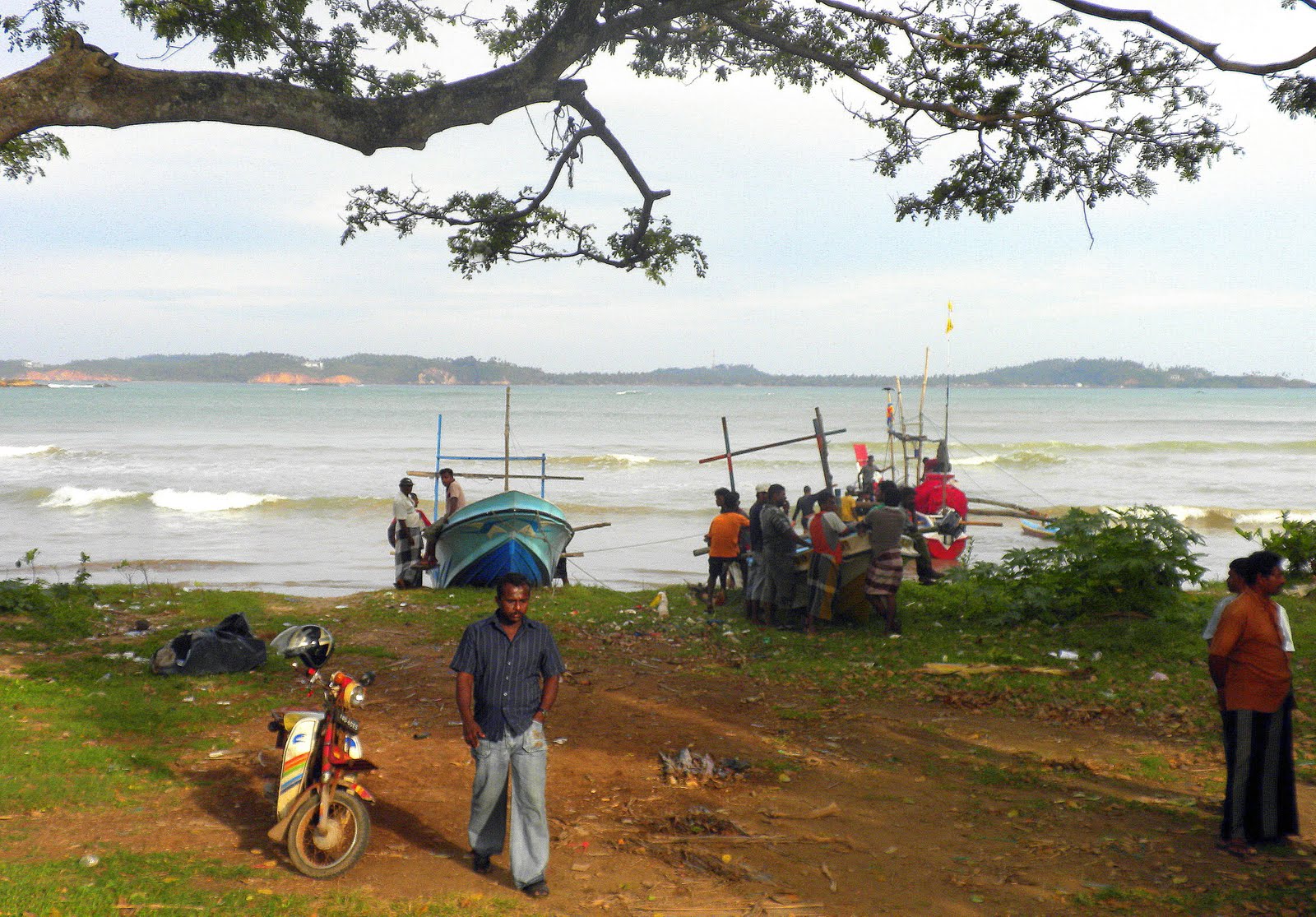
At last we were at the coast. The fishermen were in with their catch.


Some were selling by the side of the road.


Some, apparently just had to wait for their customers to come to them.


We continued driving and saw some of the area’s traditional stilt fishermen.


once again waiting precariously for their catch. They completely disappeared after the tsunami of 2004, so I’m glad they’re back.
I was tired and the sun had nearly set when we pulled up at last to the hotel.
How far had we travelled, I asked.
The answer?
119 kms (74 miles)!

November 3, 2010

Little England Indeed

I woke up the next morning to a faint sound I didn’t recognize at first. I listened. Could it be the Muslim call to prayer? I got up and pulled back the curtains, thinking I’d step out onto my small balcony to hear better. Oh no! It was raining!
After breakfast I went to meet Lankesh. He was cheerful, as always, and ready to take me to visit the town. But I had seen nothing yesterday that I wanted to explore in the drizzle.
I thought another massage sounded like a much better morning activity. Perhaps, the weather would be nicer in the afternoon.
He knew of a massage center and took me there with an indulgent smile.


This place was more for locals than tourists. But they spoke a little English and were happy to see me.


The masseuse asked me if I wanted “hard or soft massage”.”Medium” I replied. Soon, I was very glad I had not said “hard”! Afterwards, I went into the steam bath box and someone gave me a facial. I felt wonderful as I sipped my tea in the lounge before getting dressed.
But it was still raining.
The weather did not clear after lunch but I was out of excuses. So off we went to explore Little England.
Nuwara Eliya was founded in 1846 by Sir Samuel Baker -- British explorer, army officer, naturalist and big game hunter. The British planters and civil servants who lived here or came for the season named it Little England. They built houses “just like home” and the moderate climate allowed them to grow the same flowers, fruits and vegetables they were used to. These houses and gardens are still doing well. “English Country Garden, Mum” Lankesh exclaimed enthusiastically, not once but several times.
We got out to walk through the graveyard of the Old Trinity Church, built at the town’s founding and still in use today.


Almost all of the gravestones are inscribed with British names, most from the 19th century but some much more recent.
Next stop was the racetrack. They were getting ready for some event and a few hardy local people were having rides on horses.


A few minutes later, when I saw Victoria Park, I wanted to go in.


Lankesh parked near the place where the tuk tuk drivers were waiting patiently for passengers, having draped their open taxis with “raincoats”.


I was surprised to see that that there were, in fact, quite a few family groups in the park.


Many had picnics they were trying to enjoy.


Wasn't there a more pleasant occupation for a drizzly Friday afternoon? Suddenly, it struck me. Today was Eid, the end of Ramadan. (It was a call to prayer I had heard that morning). The people in the park were Muslims – another minority ethnic group who work on the tea plantations. They had planned to picnic in the park and they were going to picnic in the park – despite the weather. Just like in England.
Soon, I had finished my stroll. As the only westerner in the Park at the time, I’d replied to many friendly greetings and been giggled at by dozens of small children. Now, I thought, it was time to to go back to the hotel and participate in another popular English custom – having a drink by the fire.


Tomorrow would be another day. If I was good, maybe I’d be back in Sri Lanka.

November 2, 2010

A Mansion in the Hill Country

I was looking forward to seeing my next hotel – another of the “traditional hotels” my travel agent had booked for me. It was called St Andrew’s and, I was told, used to be a favorite haunt of the English living in Ceylon. It certainly looked the part with its wood paneling and cozy furniture. The “Welcome Drink” was a small cup of hot soup. It tasted wonderful especially because – for the first time since I arrived – I was a little chilly.
I went to my room.


No air conditioning – but a small space heater just in front of the sofa. Maybe I was in England!
Though St Andrew’s has been owned by a Sri Lankan chain since 1987, they are proud to share its history with their visitors.
The building dates from the end of the 19th or early 20th century. It was, first, the home of a “Servant of the Crown”, then a “Scot’s club” – golf outside and billiards inside – which is when it gained its name. During World War I, a group of Ceylonese investors led by a “hotelier and race horse owner” named Arthur Ephraim bought it and transformed it into a hotel. Nuwara Eliya, the town where St Andrew’s is located, was, at this time, a place many English residents of Ceylon visited to get away from the hotter weather elsewhere. The Season was from December to April with two annual race meetings, a tennis tournament, a golf tournament, a flower show, and a horse show. A hotel must have seemed like an excellent business proposition.
During World War II, Saint Andrew served as a rest and recreation center for British servicemen.
Less frivolously, after Independence in 1948, the new Sri Lankan government set up offices here to process the numerous applications for citizenship of the Indian Tamils who worked on the surrounding tea estates and had never been considered citizens of the country before.
Nowadays, tourists and Sri Lankans alike come here to relax and enjoy the calm and coolness of the hill country.
Soon, I came out to explore. In the lobby, I saw a sign that said “Tea Terrace”. That looked promising. Suitable, too, since it was just after 4 p.m. There, I met a friendly Irish couple who were finishing a magnificent afternoon tea. They invited me to join them while I had mine and we had a good chat while I tucked into an afternoon tea the likes of which I hadn’t seen since the last time I was at Fortnum and Mason in London. I almost forgot to take a picture to show you but here it is – there’s still some left.


Shortly after I finished, Carmel said, wonderingly “I’m feeling a bit cold.” I was too, so we went inside – just before it began to drizzle. Somehow that seemed appropriate.
I was sitting in my room, wondering whether I actually needed another meal that evening, when there was a knock on the door.
“Turn down service, Mum” And a pleasant young man came in to turn down the bed and strew flowers on it.


Soon, there was another knock.
“Hot water bottle, Mum.”
No!
But yes. And by the time I went to bed I was glad of it. I curled myself around it and went to sleep dreaming of horse shows, tennis tournaments, flower shows – and afternoon tea.

October 31, 2010

Tea Time

We left Peradeniya and began our climb in search of Sri Lankan tea. On our way, Lankesh educated me. There are three groups of tea in Sri Lanka.
•Low Grown Tea (Pahatha rata) is grown at altitudes of less than 600 m (1900ft) above sea level.
•Mid Grown Tea (Medarata) grows in areas from 600 to 1200 m above sea level.
But, Lankesh assured me, the best tea is
•High Grown Tea (Udarata), grown above 1200m.
This area was our day’s destination.
The British had introduced tea to Ceylon in the mid-nineteenth century by importing plants from China. Several years later, they were glad they had when the coffee plantations, thriving at the time, were destroyed by a fungal disease. Plantation owners had to switch to tea or go out of business.
The Singhalese were not keen to work on the plantations so the British “imported” Tamils from India (not the same as the Tamils up north who arrived much earlier in the history of the country). Their descendents are still the main workers in today’s industry.
I found out later that the tea workers are some of the poorest people in Sri Lanka –-perhaps not surprising in a labor-intensive industry that employs mainly women and girls – some as young as twelve – who come largely from a minority ethnic group. Tourists don’t get told everything. They want us to be happy.
Early in the afternoon, we arrived at Mackwoods Tea Factory, on the Mackwoods Labookellie Estate. (The Sri Lankan government nationalized the tea estates about 40 years ago; hence the “old” British name is linked to the “new” Sri Lankan one.)


Here I learned that there is more to tea than just picking, packing and shipping.
First, tea leaves are “plucked”.


The same field can be plucked about once a week all year long.
The pluckers choose two soft leaves and a bud over and over again.


Bags of leaves come to the factory three or four times a day.


Yes this is one man carrying up to 80 kg (176 lb) of tea leaves.
The next step in the process is “withering”


The tea leaves are laid out in troughs and for 10 to 14 hours air is circulated in them to dry out any surface moisture and concentrate and break down the tea juices.
Then, the withered tea leaves are sent down this chute


to the room below. Here the leaves are rolled (twisted to bring the juices to the surface) and passed through another machine which separates the rolled from the not-yet-rolled leaves. The not-yet-rolled are sent back to try again.


The rolled leaves are put into fermentation vats for a few hours.


Did you know that tea was fermented? I certainly didn’t. But this is what makes the leaves turn brown. Then the fermented tea leaves are dried for 20 or 25 minutes.


Finally they are graded


and remaining impurities – like bits of twig – are removed.


Finally the tea is ready to be packed up and sent to Colombo to the tea auctions.


My head whirling from all this new information, I was happy to go out to the terrace and enjoy my complimentary taste of the result of all this work


and the view of the tea leaves that still had all this in their future


with a vow never to gulp down a cup of tea thoughtlessly ever again.

October 29, 2010

Strolling in the Garden

I knew there was a Botanical Garden near Kandy but it wasn’t mentioned on my official itinerary. I’m not a gardener and I don't know a lot about plants and flowers, but I’ve always enjoyed Botanical Gardens – maybe because I crossed Hope Gardens in Jamaica every day for four years on my way home from school. When I mentioned to Lankesh that I’d like to visit the Garden, he told me that, despite my itinerary, he had already planned to take me there for a few hours before we left Kandy.
The Peradeniya Royal Botanical Gardens were established by the British in 1821 on the site of a 14th century queen’s pleasure garden. The purpose, at first, was to test a series of crops imported from other English colonies -- coffee, tea, nutmeg, rubber, among others -- to see if they could thrive in Ceylon before planting them commercially. The British also planted many varieties of coconuts here – those indigenous to the Island and others -- and grew Cinchona from which Quinine, the anti-malarial drug, comes.
Plants are still studied at Peradeniya -- by the students of the nearby university and School of Tropical Agriculture among others. But, like many botanical gardens, this one has also become a tourist attraction as well as a place where foreign Heads of State are brought to plant trees in commemoration of their visit.
I knew from my first view of Peradeniya that I was going to enjoy myself.


And I did. First, I went into the plant house


where I saw dozens of different tropical plants, carefully tended .


I visited the orchid house which contains over 300 varieties of these breathtaking flowers.


These were my favorites.


Then Lankesh and I strolled around the main part of the garden. (It extends for 147 acres (60 hectares). so would take more time and energy than I had to explore thoroughly.) I contented myself with some beautiful exotic flowers,


the small and tranquil Japanese garden


and the garden’s showpiece – a Java fig tree brought in as a sapling over a hundred years ago which now covers over 600 square meters (over 6,500 square feet) – with branches propped up at regular intervals so they don’t break. It was impossible to take a picture of the whole tree, so I contented myself with this partial view from below.


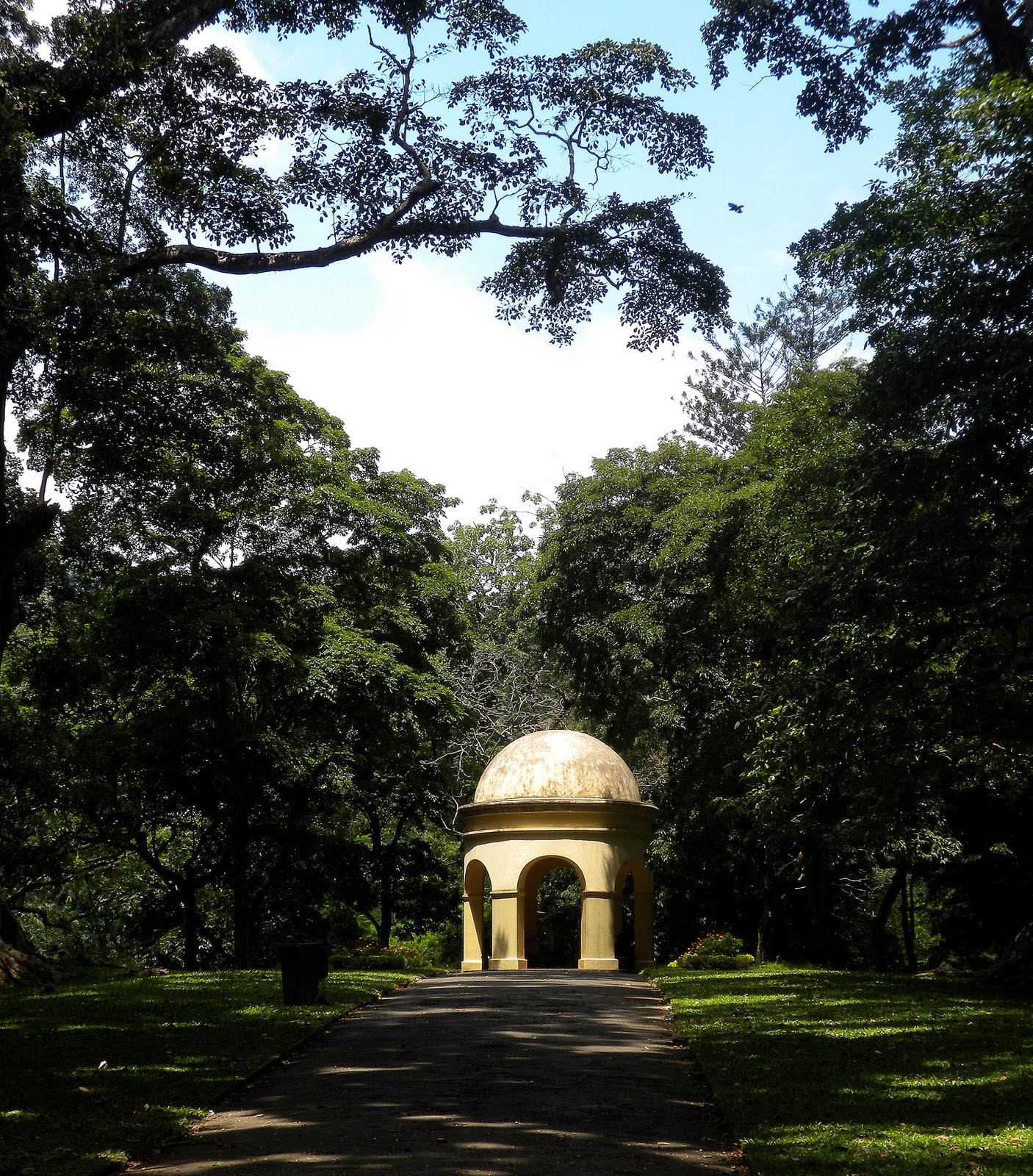
Soon it was time to leave. I caught a glimpse of this gazebo


and imagined a Sri Lankan queen or a Victorian botanist sitting in it and watching us enjoy their beautiful garden. “Thanks for sharing,” I whispered.