October 20, 2010

Madame Burdeyron’s Guest House

When I was planning my trip, the travel agent asked if I preferred modern hotels or traditional ones. Once I had ascertained that traditional hotels came equipped with modern comforts but retained their colonial charm, I chose traditional wherever possible. In Kandy it was possible.


Lankesh drove up the cobblestone drive and let me out under the portico entrance. As I walked up the marble steps flanked by large white pillars and relaxed on the old fashioned sofa sipping my “Welcome drink” of fruit juice, I knew I had made the right choice.
Though I imagine not much is left of the original building, I was told that, in the 17th century, this was the residence of the Singhalese Chief Minister of the Royal Granary. In 1818, the British acquired the building to house one of their officers who called it Haramby House. About thirty years later it was sold to Mme Burdayron of Switzerland who operated it for years as a guest house and gave it its present name. During World War II, the hotel was used as the headquarters of the South East Asia Command, under the Command of Lord Louis Mountbatten, the Supreme Allied Commander.
Though the Hotel Suisse has been owned for years by a local company and was refurbished in 1999 – to add some of those modern comforts – it strives to maintain its Victorian atmosphere. I felt like I was in an Agatha Christie novel.
After lunch on the terrace overlooking the gardens


I thought I would show some independence by taking a walk round Lake Kandy. It took me 10 minutes to cross the road – and I only managed it because the gatekeeper of the hotel took me across. Traffic in Paris is not pedestrian-friendly but at least the cars slow down! In Sri Lanka pedestrians cross when they need to – and trust to the drivers’ reflexes. I was not brave enough. During my very short walk, most of my energy was spent wondering how I was going to get back. Soon, I decided to meekly return to the hotel where I could lounge in my comfortable room


and wait for Lankesh to take me out for my evening’s entertainment.

October 19, 2010

Colonial Kandy

Leaving the spice garden, we also left the “wet zone” (the jungle area) for the “intermediate zone”.
“See the different vegetation, Mum?”
I nodded agreeably but, frankly, I didn’t. Do you?

The "wet zone"


The "intermediate zone"


Our destination was Kandy, Sri Lanka’s fifth largest city. (It has a population of only 111,700 -- evidence of the fact that 80% of the country’s people still live in rural areas.)
On our way, Lankesh told me a little of Kandy’s eventful past.
Throughout its early history, Sri Lanka was constantly being united when it had a strong ruler and divided when it did not. In the 16th century, Kandy became the capital of one of three Sri Lankan kingdoms that were created at that time. Soon afterwards, Europeans began to be interested in the Island because of the spice trade. First the Portuguese, then the Dutch fought and took over large parts of the Kingdom of Kandy, though the King himself remained ruler. By the early 19th century, the British, who had arrived a few years before as a new colonial rival, thought it was time for them to conquer Kandy. Since the Singhalese king of the time was very unpopular, some of his nobles cooperated with the British who promised to get rid of him. They did – and got rid of the independent Kingdom of Kandy, too, a few years later. No doubt not what the nobles had intended.
However, contrary to the other colonial powers, the British actually settled in Kandy and developed it. Lankesh told me that the Sri Lankans liked the English because of this. As we entered the city, he exclaimed “English buildings, Mum,” while gesturing towards buildings one would never see in England – although I was often reminded of Jamaica – another former British colony that I know better (and was British for much longer.)
There were vestiges of England I did recognize.


There were a number of these scattered around the city – all bearing the seal of King George VI – the monarch reigning at the time of Sri Lanka’s independence.
I was a little overwhelmed by all the cars and buildings.


That’s what four days in the jungle can do for you. Fortunately for my peace of mind, the last King of Kandy had had a lake built in the center of the city in 1807. It still brings serenity to the bustle.


Even more fortunately, my hotel was situated on this lake. I was eager to discover it.

October 16, 2010

The Spice of Life

« Oh! » exclaimed a friend when she heard I was going to Sri Lanka. “Will you bring me back some spices?” Spices? For me Sri Lanka meant tea. But gradually it all came back to me -- those seventh grade history lessons about the Spice Trade. I enjoyed learning history that year – stories of explorers, pirates, shipwrecks in exotic locations and international rivalry. But I was always puzzled about why all those men travelled long distances and put their lives in danger to bring cinnamon,pepper, nutmeg and vanilla to their waiting countrymen.
Later reading taught me that there the answer was a combination of business, power-grabbing, fashion and prestige – which must have seemed evident to my history teacher but wasn’t to my 12 year old self.
Europeans had been using spices long before the Middle Ages to spice food and preserve meat, as well as in perfume making, embalming, and the making of medicine. The spice trade was a monopoly of the Asian producers first and later of Muslim traders who controlled the route between Asia, where the spices grew, and Europe which wanted to buy them. They were sold for exorbitant prices which only the rich could afford. So, of course, the rich wanted them -- to prove they could afford them.
Finally, the Europeans decided to take matters into their own hands -- not to reduce the prices but to make the money themselves – first the Portuguese, then the Dutch and finally the English and French. All these nations, except the French, colonized Sri Lanka in turn between the 16th and the 20th century.
By the 19th century, refrigeration made the preserving function of spices less necessary and the prices dropped. But spices are still cultivated and sold. Sri Lanka produces 80% of the world’s cinnamon as well as cardamom, cloves, nutmeg and mace, black pepper, turmeric and vanilla.
Today I was going to a spice garden to see them.


The spice gardens tourists are taken to are commercial in nature. There are a few trees and bushes of each kind of spice.


The guide takes you around and makes you guess what the spices are and tells you their use in Ayurveda (traditional Sri Lankan and Indian medicine. I was pleased that I managed to guess most of those presented to me and surprised at how strong they smelled compared to their pale imitations sold in European and American supermarkets.
The final sales pitch was the one that pleased me most. I was taken here


and given a short lecture on the medicinal properties of various oils and balms I could buy there (everything from whitening your teeth to erectile dysfunction!). There are also Ayurvedic beauty products and, to illustrate their value, two young men gave me a wonderful massage. (No photo available) .My visit ended with the obligatory stop at the gift shop. I exited with cooking spices for myself and two friends, leaving the various oils and balms for others. For example, for the busload of French tourists that were arriving as I left. “They’ll get the lecture but I bet they won’t get the massage,” I smiled smugly to myself.

October 14, 2010

Jungle Massage

When I decided not to climb Sigiriya, I knew what I wanted to do instead. Lankesh had been telling me since I arrived that he knew of a good massage place near my hotel. “Special herbal massage, Mum.” So I decided that while the more adventurous were climbing the mountain, I would be pampered.
After our brief look at Sigiriya, he drove me to the massage place


where the owner greeted me. He explained that the basic charge included a one-hour massage, use of the sauna and a steam bath. And what was this basic charge? The same amount I would have spent to climb Sigiriya. It was fate!
He introduced me to my masseuse


and off we went. The massage was wonderful – not too hard, not too soft. I assumed that they called it “herbal massage” because the oil was perfumed with herbs. But the herbal part didn’t end there. She led me to the sauna.


As I sat on a stool made of a tree trunk with squishy herbs at my feet and contemplated the other herbs hanging from the ceiling, I thought: “They should call it the Jungle Sauna.”
But my surprises were not yet over. After the sauna, I was led to the steam bath.


Yes indeed. She gestured that I was to lie down on the herbs. Then she closed the lid on me so only my head was visible. (Look at the photo below and imagine my head peeking out.)


She gave me a facial while I baked gently in my herbal oven.
All too soon, it was over. I had a cup of tea, got dressed, bowed and smiled.Then Lankesh took me back to the hotel.
Often a massage makes me want to sleep. This one energized me instead. After lunch, I spent the afternoon in the swimming pool, contemplating Sigiriya in the distance. That evening I sipped the on-the-house apéritif the hotel owner gave me for my last evening at Kassapa and, after dinner, went back to my chalet to enjoy the giant fruit basket that had been brought to my room to say “Thank you and goodbye.” Still relaxed, but not at all exhausted, I went to bed and wondered what new adventures the next day would bring.

October 12, 2010

The Mountain I Didn’t Climb

In Sri Lanka, one of the sights on every tourist’s itinerary is Sigiriya – another of the country’s eight Unesco World Heritage sites.
Sigiriya -- also called the Lion’s Rock -- is the ruin of the 4th century palace and fortress of King Kassapa. Since Kassapa had killed his father and taken over the throne that should have gone to his brother, it was understandable that he should look for a very safe place to live.


I had seen Sigiriya every day from my hotel and Lankesh dropped it into the conversation daily, too.
Sunday it was an encouraging “Lots of tourists climb it – even older than you, Mum. (thanks Lankesh!) If they have trouble, there are men who lift them under their shoulders and help them.”
Monday it was a casual “I once took some tourists to Sigiriya. They started up but didn’t want to go all the way. It’s a shame because they had spent their $25.” (For reasons I never understood, some sites actually base their prices for tourists in American dollars and charge according to the dollar – rupee exchange rate of the day.)
Monday afternoon, on our way back from Minneriya, Lankesh told me that the climb would be an hour and a half up and another hour and a half down. We should leave the hotel by 8:30.
I gazed at the Rock that evening while sipping my coconut juice apéritif. During dinner, I weighed the pros (palace ruins, frescoes, beautiful view of ancient gardens – and bragging rights) and the cons (three hours climbing up and down, scariness of the stone steps, possible utter exhaustion for the rest of the day – ominously there was nothing on my program for the afternoon) By bedtime I’d made up my mind. Sigiriya would have to survive my not climbing up to see it.
I think Lankesh was relieved when I told him, though he was far too polite to show it. He told me we’d go there and he’d tell me its history at the site.
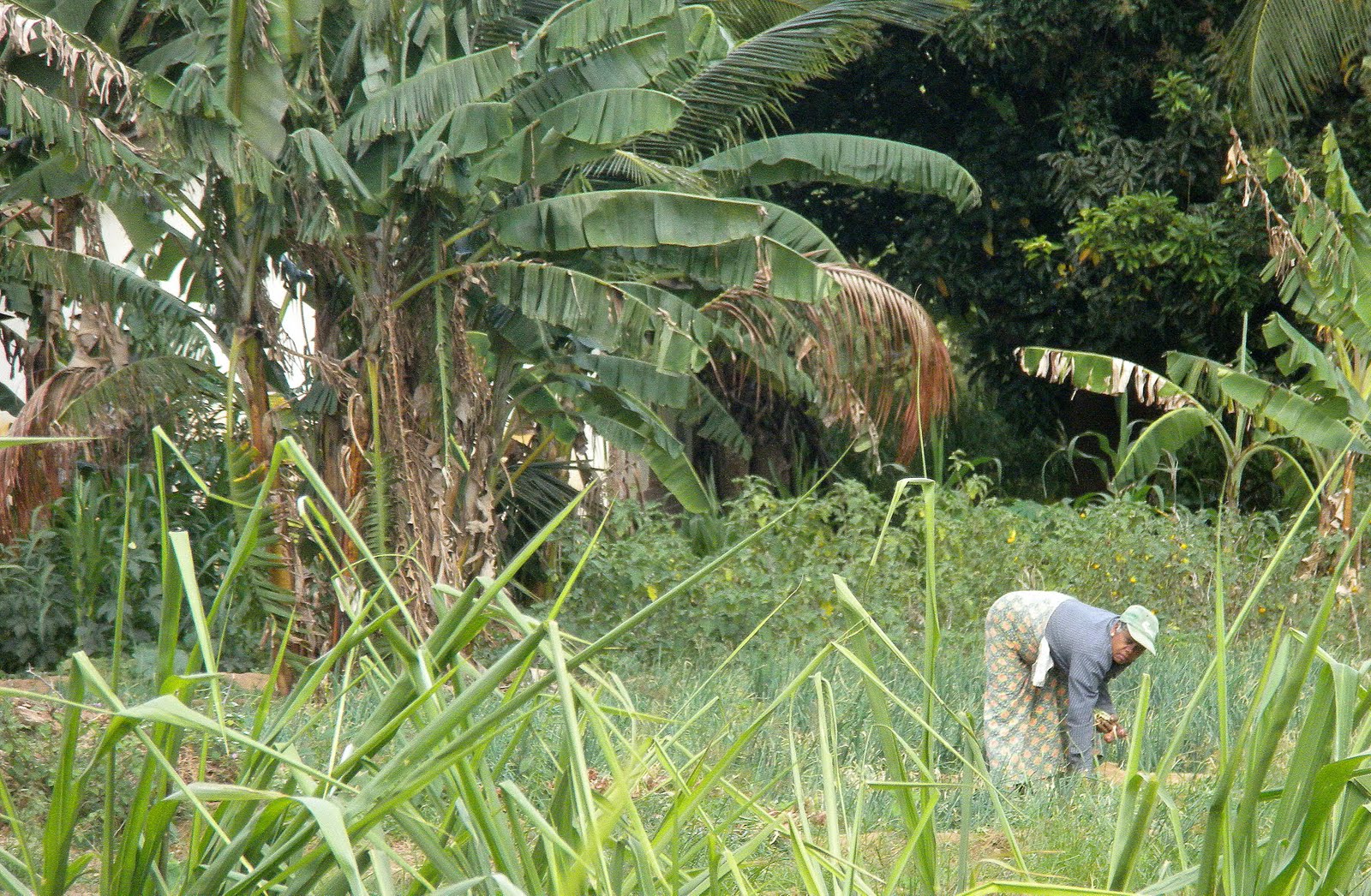
No longer pressed for time, we meandered through the jungle roads. I stopped to take a picture of a woman tending her plot of land.


and another of a treehouse. Lankesh explained that the farmers who didn’t have a house on their land slept in them because of the wild elephants which still roamed the area.


Soon we arrived at the moat that still protects Sigiriya.


I saw some intrepid tourists lining up to buy tickets and begin their morning’s climb.


Click here to see what awaited them – and some of the stairs I didn’t climb.

Soon, we said goodbye to the Lion’s Rock. Lankesh tried to show me where the climbers were walking. Do you see any?


I didn’t -- except those still on the ground, of course. I left with no regrets, except when I thought of telling fellow tourists and friends at home that I hadn’t been one of those hardy visitors. Mostly, though, I was looking forward to the substitute morning activity I’d planned.

October 9, 2010

Safari!

No sooner had my feet touched the ground after my elephant ride, than I was whisked into a jeep and driven a short distance to Minneriya National Wildlife Park.
This nearly 22000 acre (8890 hectare) area is home to over 400 species of birds

on land


(Colorful as a parrot but wrong beak. Pretty whatever he is.)

in the air


(I was told this was an eagle.
And this is definitely an eagle’s nest.)


and,near the Minneriya tank (reservoir), built in the 3rd century AD by King Mahasena
ibises and storks are plentiful.


Water buffalo use the Tank, too.


As do fishermen.


But, they were not what I had come to see.
I had been promised elephants.
September is the end of the dry season in this area. The tank attracts elephants from far and wide whose normal drinking places have dried up.
Ah there’s one.


A male, I was told. Males live alone after about age 12 to 15 and only “visit” females at 16 week intervals when mating can take place. Not every female is interested, each time, of course. The gestation period for an elephant is 22 months -- ensuring the young will be born in the rainy season -- and the mother feeds her baby for two or three years. The females live together in groups that stay close throughout their lifetime. The oldest female is the head of the group and all the elephants help take care of all the babies, though, of course, their own mother nurses them.
But where were they?
Ah!


The jeep drivers gathered and soon small herds of tourists were watching small herds of elephants.


Most of them were eating while we watched.


They had no time to lose. Elephants need between 149 and 169 kg (330-375 lb.) of vegetation each day and spend nearly 80% of their waking hours feeding.
Suddenly, as if at a signal, some of them trotted off to the Tank.


They looked like they were enjoying themselves – especially the baby.


The guide said that the groups go in the water together one group at a time. Very organized.
We watched them until it was time to leave.
What a great afternoon.

October 7, 2010

Let's Go for an Elephant Ride

When I was preparing my itinerary, I was told I could ride an elephant one day for a small supplementary fee. That sounded fun and exotic and I immediately said “Yes.”
As I got in the car on the appointed afternoon, I began to have doubts.
I am the person who rode a camel in Egypt and whose camel boy spurned the money our guide said was a fair price and refused to have the camel kneel until I gave him more. I was saved by a fellow-traveller who was able to argue with him in Arabic.
I am the person who fell off a horse that wasn’t moving in the Camargues. I dropped the reins to take a picture; he bent his head to graze and I rolled off his shoulder.
Naturally, I didn’t express these chicken-hearted thoughts to Lankesh as he told me about Sri Lankan elephants on our short trip to meet mine.
Elephants have been in Sri Lanka for over 5000 years. At first, they were the property of the Kings and the penalty for killing one was death. Much later, the British hunted elephants for sport. As agricultural lands took more of the jungle, Sri Lankans killed elephants who trampled their crops. By 2007 there were only about 3000 wild elephants left, many of them in two national parks. By law elephants cannot be used as pack animals any more but only ridden on ceremonial occasions – or by tourists. The tourist elephants are well taken care of. They are checked regularly by veterinarians and may only work 5 hours per day.
I arrived in time to see them prepare my elephant for me.
First she was given a bunch of palm leaves to eat to distract her.


While she ate, they got her ready.


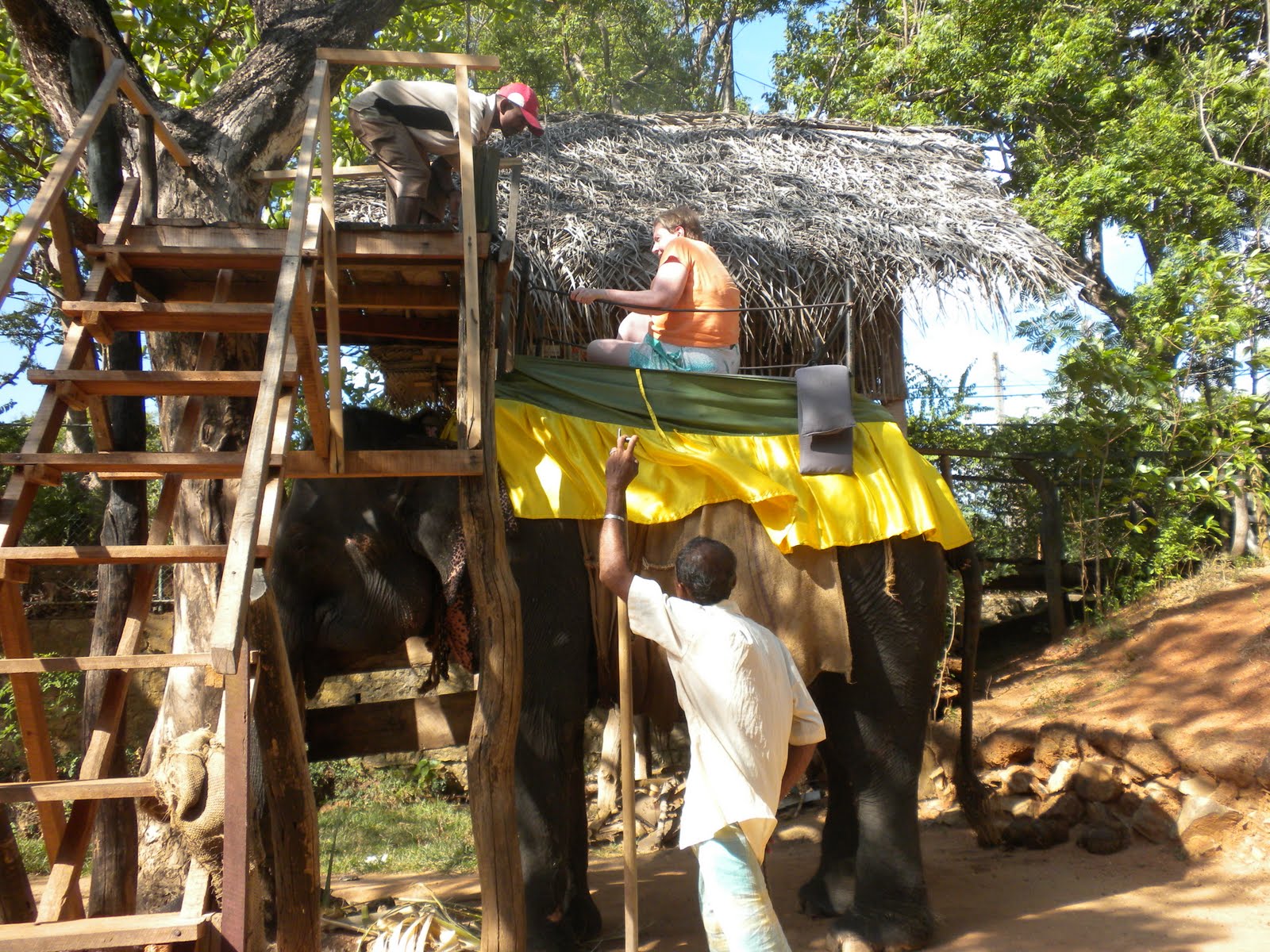
Then it was time for me to climb up the steps and get on.


Well I’m as ready as I’ll ever be.


We started off.


The elephant driver walks beside the elephant with a pole to guide her. His assistant walks behind them with your camera to record your ride for posterity. That part they told me. The part they didn’t tell me was that the first 10 minutes of our ride would be ON THE ROAD –- with lorries honking and Sri Lankans waving and laughing from cars, buses and motorcycles while I repeated to myself that the elephant was used to this and nobody was going to get hurt.
My elephant eventually plodded sedately across the road to her familiar path and we were – well not in the jungle exactly but at least off the road.


A lady drawing water from a well looked up as we passed. A man stood, put his two hands together and bowed. I hoped that it was just the traditional greeting and not a prayer for my safety!
Just as I was beginning to relax, the assistant threw me a mango and told me to give it to my elephant. That meant I’d have to move!


Soon we reached the river and in she went.


When she came out I definitely felt a tilt.


But I’m glad I didn’t see this picture until I was safely on the ground.
Several times on our journey we met other tourists.
I am now part of the holiday photos of some Dutch people as they are part of mine.


Then it was back to the road again with small children following and laughing and more cars and lorries and busses. But I was almost relaxed by this time.
All too soon we were back where we started. Time to unfold my legs and try to get out of my cage.


No photo is available of the men hauling me up and out!
How did I feel? Well, I wasn’t actually humming “Let's Go for an Elephant Ride”. But I was smiling inside. I’d done it; I’d survived – and I was already planning this story.